
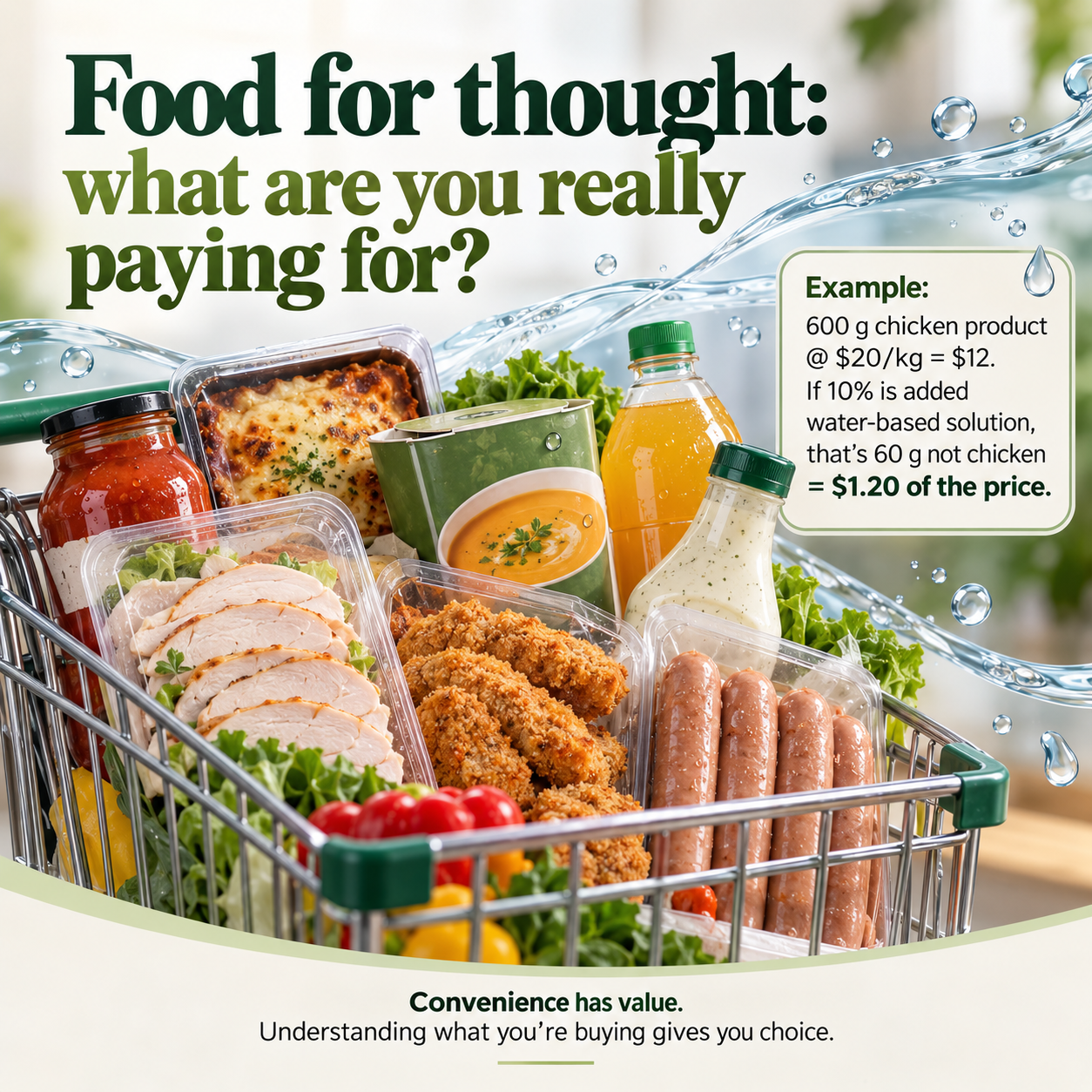
We are all feeling the price of groceries. Every week people talk about how much food costs, how hard it is to make the budget stretch and how expensive it has become to feed a family.
But there is another side to this that I think we overlook. Convenience.
We are not always paying for the ingredient itself. We are often paying for someone else to cut it, mix it, season it, coat it, cook it, package it, portion it and make it easy for us. And convenience has a price.
My experience working as a product manager in food production taught me to look at products differently. I look at yield, weight, what has been added, what has been removed and how much of the product is actually the ingredient you think you are buying.
Take chicken as a simple example. A 600 g pack at $20 a kilo costs $12. If 10% of that finished product were an added water-based solution, 60 g of that pack would not be chicken. You would be taking home 540 g of chicken, while $1.20 of the purchase price would proportionally sit in that 60 g portion.
One pack does not sound like much. But across 100 kg of product, 10% becomes 10 kg. At $20 a kilo, that is $200 of retail value attached to something other than the chicken itself.
Now think about everything else we buy for convenience. Ready-made sauces, curries, gravies, marinades, crumbed meats, battered products, sausages, deli meats, pre-made meals, drinks, soups, stocks, dressings and desserts.
Every time an ingredient is stretched, diluted, coated, processed or turned into a finished product, we are paying for more than the main ingredient.
Sometimes that is absolutely worth it. People are busy. People are tired. Not everyone has the time to cook from scratch. Convenience is not the enemy.
But I do think we should understand what we are paying for.
There is a difference between paying for chicken and paying for a chicken product. There is a difference between paying for tomatoes and paying for a finished pasta sauce. There is a difference between paying for meat and paying for meat plus coating, liquid, starch, seasoning and processing.
The product might still be worth the price, but at least you know what you are buying.
That is the part I think has been lost. Food knowledge.
Understanding yield. Understanding labels. Understanding how to make something yourself when you need to save money. Understanding when convenience is worth paying for and when it is costing you more than you realise.
The answer is not that everyone should cook everything from scratch. That is not realistic.
The answer is knowing enough to make the choice.
Because sometimes the most expensive part of the product is not the food.
It is the convenience.
Food for thought: what are you really paying for?