
Businesses have long understood the importance of knowing what stock they have, managing portions, reducing waste and getting the greatest useful value from the ingredients they buy. These principles help a business control costs and protect profit.
A Pantry Challenge brings the same practical thinking into the household kitchen—not to run your home like a company, but to help you understand what you already have, what you genuinely need to buy and how to get more value from your food spending.
Most households were never taught to look at food in terms of stock, yield, repeated use and waste. We are usually shown the finished product or the finished recipe. We are not always shown how much of the main ingredient we are receiving, how many useful portions it creates or how one purchase can continue working across several meals.
A Pantry Challenge begins with a simple question: what value is already sitting in your kitchen?
What is a Pantry Challenge?
A pantry challenge means checking the food already in your cupboards, fridge and freezer and using it before automatically buying more.
Some people complete a pantry challenge for a week or a month. Some call it a pantry clean-out, a no-buy challenge or shopping from the pantry. Those short challenges can be useful, but the greatest value comes when the thinking continues after the challenge ends.
At Pantrix, Pantry Challenge means building a practical, repeatable habit:
- Know what you already have.
- Understand what you are buying.
- Choose ingredients that can work in more than one way.
- Buy only what is genuinely missing.
- Use what you buy before starting over again.
It does not mean never buying groceries, removing every convenience or cooking everything from scratch. It means making purchases with greater awareness and using the food you have already paid for with more purpose.
Your pantry already holds value
Every ingredient in your pantry, fridge and freezer represents money that has already been spent. When it is forgotten, duplicated or discarded, some of that value is lost.
The Australian Government reports that Australia wastes around 7.6 million tonnes of food each year. Households account for about 2.5 million tonnes, or roughly 30 per cent of the total. No household will eliminate every bit of waste, but checking what is already available before shopping is a practical place to begin.
This is not about guilt. Plans change, people change their minds and unexpected things happen. Pantry Challenge is about noticing what is there early enough to make a choice.
Before you buy more, check what you have already paid for.
What are you really paying for when you buy convenience?
Convenience has genuine value. A premade meal can save time, preparation and cleaning. Its price may also cover labour, processing, packaging, transport, storage, marketing and retail costs—not only the food inside.
Pantry Challenge is not about saying convenience is bad. It is about understanding what you are receiving for the price and deciding whether that value suits your household.
When comparing a premade product, do not look at the package size or total weight alone. Check:
- The net weight of the product.
- The number of realistic portions for your household.
- The ingredient list.
- The amount or percentage of the main ingredient or protein, where it is shown.
- The cost per portion.
- The time and work the convenience saves you.
For a meat-based meal, the useful question is not simply how heavy the package is. It is how much meat or protein you are actually receiving, what else is included and how many people the product will realistically feed.
Australian packaged-food labels generally list ingredients in descending order by ingoing weight, and many products show the percentage of a key or characterising ingredient. This can help people compare similar products more carefully.
The goal is not to prove that home cooking is always cheaper. The goal is to know when you are paying for convenience—and choose it knowingly.
Businesses understand that bulk buying is only valuable when the stock is used
Buying a larger pack does not automatically create a saving. A business can obtain a lower unit price and still lose value if the stock sits unused, expires or has only one purpose.
The real value of bulk purchasing comes from frequency and flexibility. Businesses are more likely to buy larger quantities of ingredients they use regularly, understand well and can use across several products.
The same principle applies at home.
A bulk purchase can make sense when it is an ingredient your household genuinely uses, can store safely and can turn into several different meals. It may not be good value when it is bought only because the pack is larger, the unit price is lower or the product is on special.
Buy more of what you genuinely use—not more of what you may never use.
The more uses an ingredient has, the harder it can work
A business tries to avoid buying a completely separate set of ingredients for every product it makes. Ingredients that can be used repeatedly reduce the need to keep purchasing new stock for every individual outcome.
Households can use the same thinking without turning dinner into a production line.
A versatile ingredient may contribute to several breakfasts, lunches, dinners or sides. The more planned uses it has, the easier it becomes to finish the pack, reduce forgotten leftovers and limit the number of separate ingredients required in the next shop.
This does not mean eating the same meal repeatedly. It means allowing the same ingredient to take on different roles.
The value is not only in the size of the pack. The value is in how many useful outcomes you can create from it.
The household version of profit
A household does not earn a financial profit by cooking dinner, but it can protect value.
When an ingredient already owned replaces something that would otherwise be purchased, the household avoids paying for it again. When one purchase contributes to several meals, its value is spread further. When food is stored and used safely instead of being discarded, another purchase may be avoided.
This is what Pantry Challenge means by keeping more value inside your kitchen.
It is not a promise that every household will save the same amount. Food prices, household size, dietary needs, cooking confidence, available time and existing pantry contents are different for everyone.
The honest claim is simpler: knowing what you own, buying with purpose and reducing avoidable duplication or waste can help a household use its grocery budget more effectively.
Why businesses have used these principles for years
Inventory management is a normal part of business. Businesses track what stock is on hand, what needs to be ordered, when to restock and which items are moving slowly. Good stock records support better purchasing decisions and can reduce over-ordering and waste.
In food production, those decisions also include portions, usable yield, storage life and repeated ingredient use. A successful result is not created by buying the cheapest ingredient or the largest pack. It comes from understanding how that ingredient will be used and how many useful products or portions it can create.
Households do not need spreadsheets, stocktakes or rigid controls to benefit from the principle. They only need to pause before shopping and ask:
- What do we already have?
- What needs to be used first?
- What meals can these ingredients contribute to?
- Which missing items will connect what we already own?
- Is the larger pack genuinely useful for us?
- How many realistic portions are we receiving for the price?
From a short challenge to a lifelong habit
A traditional pantry challenge may finish when the cupboard is cleared or the nominated week ends. The Pantrix approach asks what happens next.
Do we return to buying ingredients for one isolated recipe at a time? Do we gradually rebuild a pantry of duplicates and unfinished packets? Or do we carry forward what the challenge revealed?
Pantry Challenge can become a lasting habit:
- Check before shopping.
- Use the most perishable or valuable ingredients first.
- Choose meals that share useful ingredients.
- Buy versatile products your household actually uses.
- Compare convenience products by useful portions and main ingredients—not packaging alone.
- Review what remained unused before repeating the same purchase.
Success is not measured by how empty the pantry becomes. It is measured by how confidently the household understands, chooses and uses what is inside it.
Why I created Pantry Challenge
I did not arrive at Pantry Challenge through recipes alone.
My understanding comes from more than forty years of hands-on food experience as a chef and butcher, together with my experience in management, production and running businesses.
In those environments, every ingredient has a cost. Portions matter. Yield matters. Waste matters. Organisation matters. What is purchased, what is used and what remains all affect the final result.
Yet these principles are rarely translated into ordinary household language. Consumers are frequently sold the finished convenience, but they are not always shown how to assess the value inside it or how the same core ingredients could keep working in their own kitchen.
Pantry Challenge was created to bring that understanding home—not to remove choice, criticise convenience or expect everyone to become a chef.
It is designed to give people a place to begin, a little structure and the confidence to make informed choices for themselves.
Michelle Hanlon
Founder of Pantrix
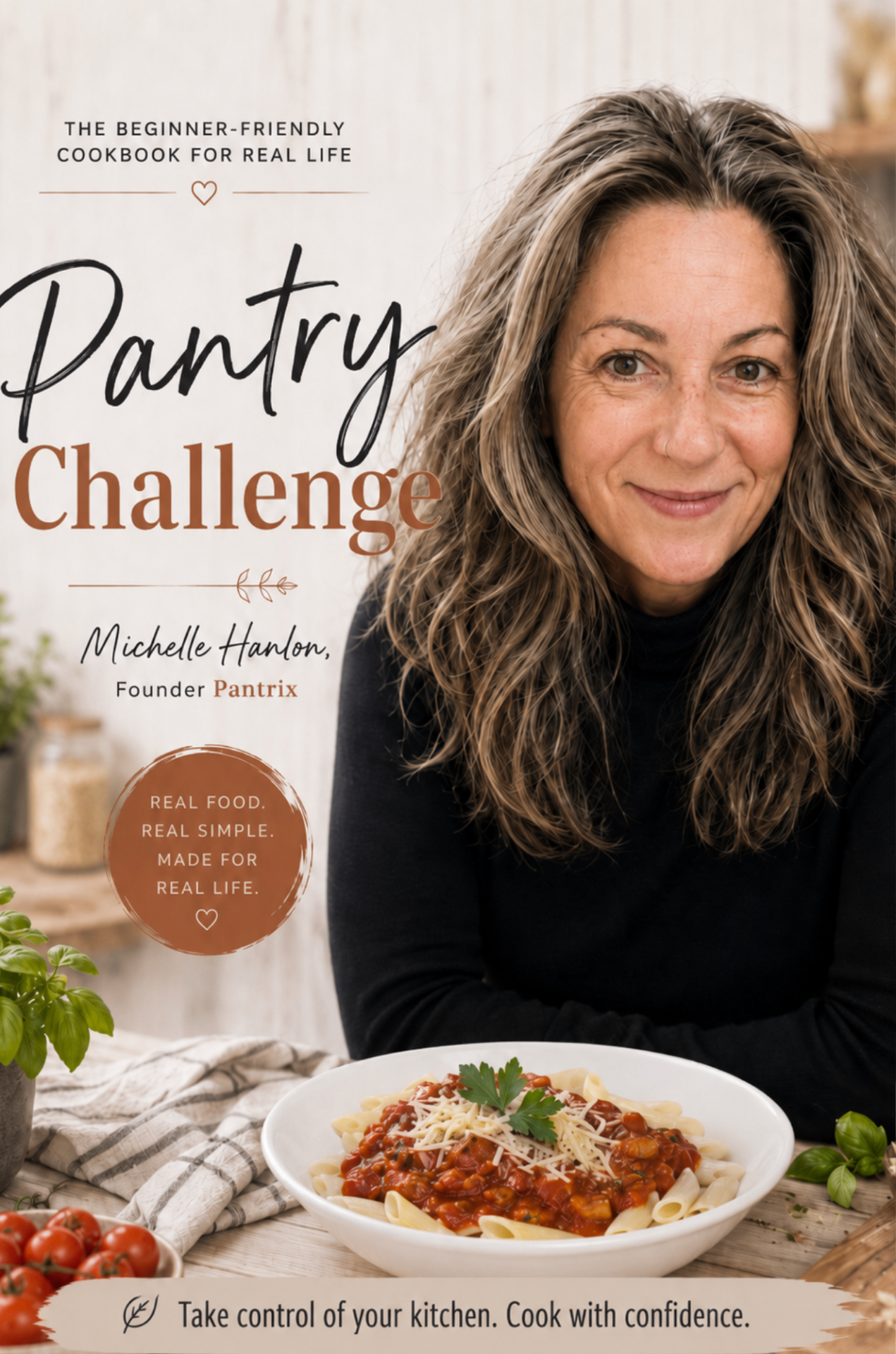
The Pantry Challenge books help you begin
The Pantry Challenge books provide a practical starting point for people who may feel overwhelmed by shopping, planning or cooking.
They bring the planning together so readers can begin with clear guidance, use ordinary ingredients with more purpose and build confidence one meal at a time. The books are not about cooking perfectly or revealing a rigid formula. They are designed to help people see how one organised approach can create more than one outcome.
Two editions are available: Meals for 2 and Family of 4.
The Pantry Challenge books help you begin. Pantrix helps you keep going.
Pantrix ties everything together
Pantry Challenge begins with awareness. Pantrix is designed to help make that awareness easier to use in everyday life.
Instead of beginning with a recipe and buying every ingredient it requests, Pantrix begins with the household: what is already available, how many people need to be fed, dietary needs and allergens, equipment, preferences and the realistic amount of time available.
From there, Pantrix is designed to connect what the household already has with meal possibilities and identify what is genuinely missing.
The goal is not to control what people eat. It is to give people greater control over how their kitchen works.
How to start a Pantry Challenge
- 1Check what you already have — Look through the cupboards, fridge and freezer. Move items, check opened packets and note food that needs to be used soon.
- 2Start with what may be lost first — Identify perishable foods, leftovers, opened products and higher-value ingredients that may otherwise be wasted.
- 3Choose ingredients with more than one use — Think beyond one recipe. Look for ingredients that can contribute to several different meals or sides.
- 4Remove owned items from the shopping list — Do not buy an ingredient again simply because it appears on a standard list. Check whether you already have enough.
- 5Buy what is genuinely missing — A Pantry Challenge does not have to be a no-buy challenge. Purchase the connecting ingredients needed to turn what you own into complete meals.
- 6Review what remains — Notice what was repeatedly avoided, wasted or bought in the wrong quantity. Use that information to improve the next shop.
Frequently asked questions
Does a Pantry Challenge mean I cannot buy groceries?
No. Some people choose a temporary no-buy version, but the Pantrix approach is to use what is already available and buy only what is genuinely missing.
Is buying in bulk always cheaper?
No. A lower unit price only becomes useful when the household can store and use the product before it is wasted. Bulk buying works best for ingredients the household regularly uses in several ways.
Are premade meals poor value?
Not necessarily. Convenience can be worthwhile. Value depends on the price, quantity, realistic portions, main ingredients, quality and how useful the saved time and preparation are to the household.
How should I compare a premade meal?
Check the net weight, ingredient list, percentage of the main ingredient where declared, realistic number of portions and cost per portion. For a meat-based meal, look at how much meat or protein is actually included—not only the total package weight.
Can a Pantry Challenge save money?
It can help a household avoid duplicate purchases, use food that has already been paid for and reduce avoidable waste. Actual savings will vary, so Pantrix does not promise one set saving for every household.
Is Pantry Challenge only a short-term clean-out?
It can begin that way, but its greatest value is as a repeated habit: check what you have, understand what you buy, choose versatile ingredients and use them well.
Keep the value in your kitchen
Your pantry is not just a cupboard. It holds ingredients, choices, possibilities and money that has already been spent.
A Pantry Challenge helps you recognise that value before buying more. It helps you understand what convenience offers, decide when it is worthwhile and make ordinary ingredients work harder for your household.
You do not need a perfect kitchen or a complicated system. You simply need to begin with what you already have.
Take control of your kitchen.