
I recently went to the supermarket for a few things.
You know how that goes.
A few things became a full trolley.
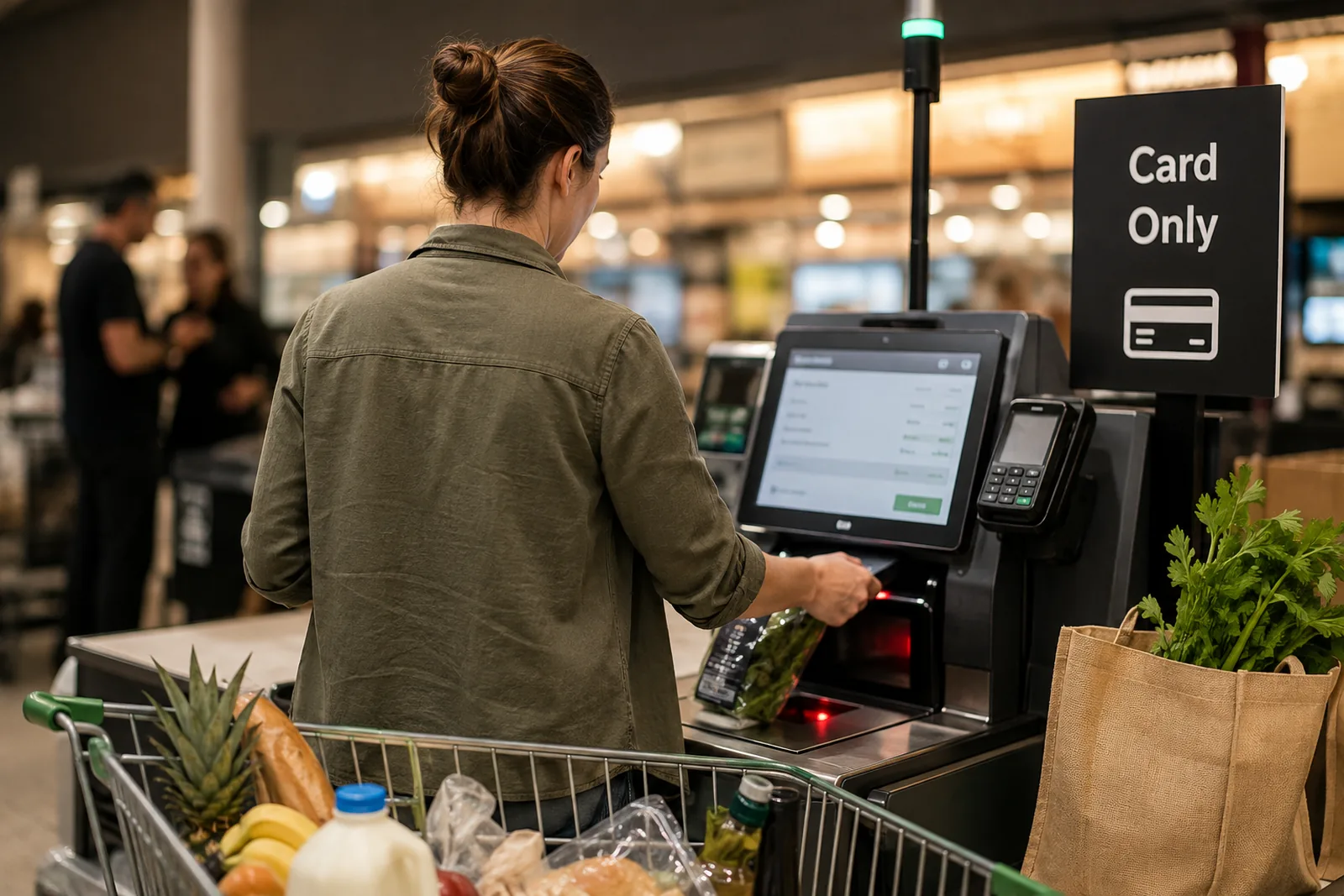
I headed towards the checkouts and, on that visit, found one staffed checkout operating while the self-service area was full.
So I joined self-service.
I scanned my groceries.
I packed my groceries.
I supplied my bags.
Then the machine stopped and I needed assistance.
I continued.
It stopped again.
And again.
And again.
Four interruptions during one shop.
At one point I looked around and thought:
Hang on. Where’s my employee discount?
I’m paying for the groceries.
I’m scanning them.
I’m packing them.
I’m supplying the bags.
And I’m calling an employee over when the machine decides I can’t continue.
At one point I found myself thinking:
I’m working. They’re being paid. And I’m interrupting them to get permission to continue working.
If I’m going to work here, surely I should at least get staff benefits.
It made me laugh.
Then it made me think.
I Remember When Going to the Shops Felt Like Seeing a Friend
My first job was at KFC.
My next was in a small supermarket, where I worked until I finished college.
And I remember when customer service actually meant knowing your customers.
We joked with them.
We talked while we scanned their shopping.
We heard about their kids, their work, what they were cooking for dinner and whatever else was happening in their lives.
We knew regular customers by name.
Someone would walk through the door and we’d say hello before they’d even reached the checkout.
I’d joke around and ask someone for ID for their onions or say something ridiculous just to make them laugh.
It wasn’t scripted customer service.
It was human.
Over time, customers weren’t simply transactions waiting at the till.
You got to know them.
Going to the shops could almost feel like going to see a friend.
And for someone living alone, that little conversation at the local shop might have been one of their few human interactions that day.
That’s the part I think we’ve quietly lost.
Somewhere along the way, we started treating human interaction as an inefficiency that needed to be removed.
Technology Should Make Things Better
I’m not against self-service.
If I have five items and can scan them quickly and walk out, fantastic.
That’s convenience.
But a full trolley is different.
If I’m scanning and packing an entire shop myself while repeatedly waiting for somebody to override a machine, I have to ask:
What exactly became more convenient for me?
I’ve run businesses myself. I understand why businesses look for efficiency.
But there’s a difference between improving efficiency and simply transferring part of the work to your customer.
If customers are performing more of the work, there should be something in the equation for them.
Faster service.
Better prices.
Greater convenience.
Something.
Otherwise, we’ve simply changed who is doing the work.
We’re Doing More — While Questioning What We’re Getting for Our Money
And this isn’t happening in isolation.
Prices change.
Pack sizes change.
There are specials, loyalty offers, multi-buys, convenience products and different-sized packages competing for our attention.
Sometimes working out which product actually represents better value takes more effort than it should.
That’s not simply me overthinking a shelf label.
The Australian Competition and Consumer Commission says unit pricing helps shoppers compare similar products and find the best value for their money. Most large supermarkets and online grocery stores are required to display unit pricing for most everyday grocery products.
The ACCC’s 2025 Supermarkets Inquiry also recorded consumer concerns about confusing or ambiguous promotional terminology and signage, difficulty determining whether products were genuinely on special, and uncertainty about whether promotions represented genuine value.
So we’re not simply deciding whether we want a packet of something anymore.
We’re comparing price per kilogram or 100 grams, checking whether the larger packet really is cheaper, deciding whether buying two actually saves money and trying to work out whether a promotion represents good value for us.
Consumers shouldn’t need a mathematics degree to buy toilet paper.
Enough Is Enough
This isn’t about attacking supermarkets.
It isn’t about blaming the people working on the floor.
And it certainly isn’t about saying businesses shouldn’t make money.
I’ve owned businesses. Of course they need to make money.
It’s about asking a much simpler question:
Are consumers getting a fair exchange?
If technology saves a business money but creates more work for its customers, where is the customer’s benefit?
If we’re encouraged to buy two or three products to receive a better price, did we actually need two or three?
If packaging changes, are we still getting the same value?
If something says “special”, do we automatically assume it represents good value?
And if customer service is progressively replaced with self-service, what have customers received in return?
These aren’t accusations.
They’re questions consumers should be comfortable asking.
Because our money gives us a voice too.
Maybe Our Greatest Power Is Needing the Supermarket Less
My experience didn’t make me want to shop more.
It made me want to avoid shopping.
And perhaps that isn’t entirely a bad thing.
Because maybe one of the most powerful things consumers can do is need the supermarket less.
Not never.
Not unrealistically.
Just less.
Less wandering the aisles because we don’t know what to make.
Less buying extra items because a special makes us feel like we should.
Less repeat shopping because we haven’t stopped to look at what we already have.
Less shopping simply because shopping has become a habit.
More using what’s already in the fridge, freezer and pantry.
More making what we have work together.
More questioning whether convenience is really convenience.
More confidence.
More awareness.
More control.
Because the less dependent we are on constantly going back for “just a few things”, the more control we keep over our own choices and our own money.
And maybe that’s part of the bigger lesson.
If shopping is starting to feel like work, perhaps the answer isn’t to get better at shopping.
Perhaps the answer is to need it less.
That’s where change begins.
Not in fighting the system.
Not in attacking workers.
But in becoming more conscious consumers.
In making our food, our money and our homes work harder for us.
And in remembering that every unnecessary trip we avoid, every impulse buy we question and every meal we make from what we already have is one small decision we’ve made for ourselves.
Maybe the real employee discount is learning how to rely on the supermarket a little less.